The Framework in One Sentence
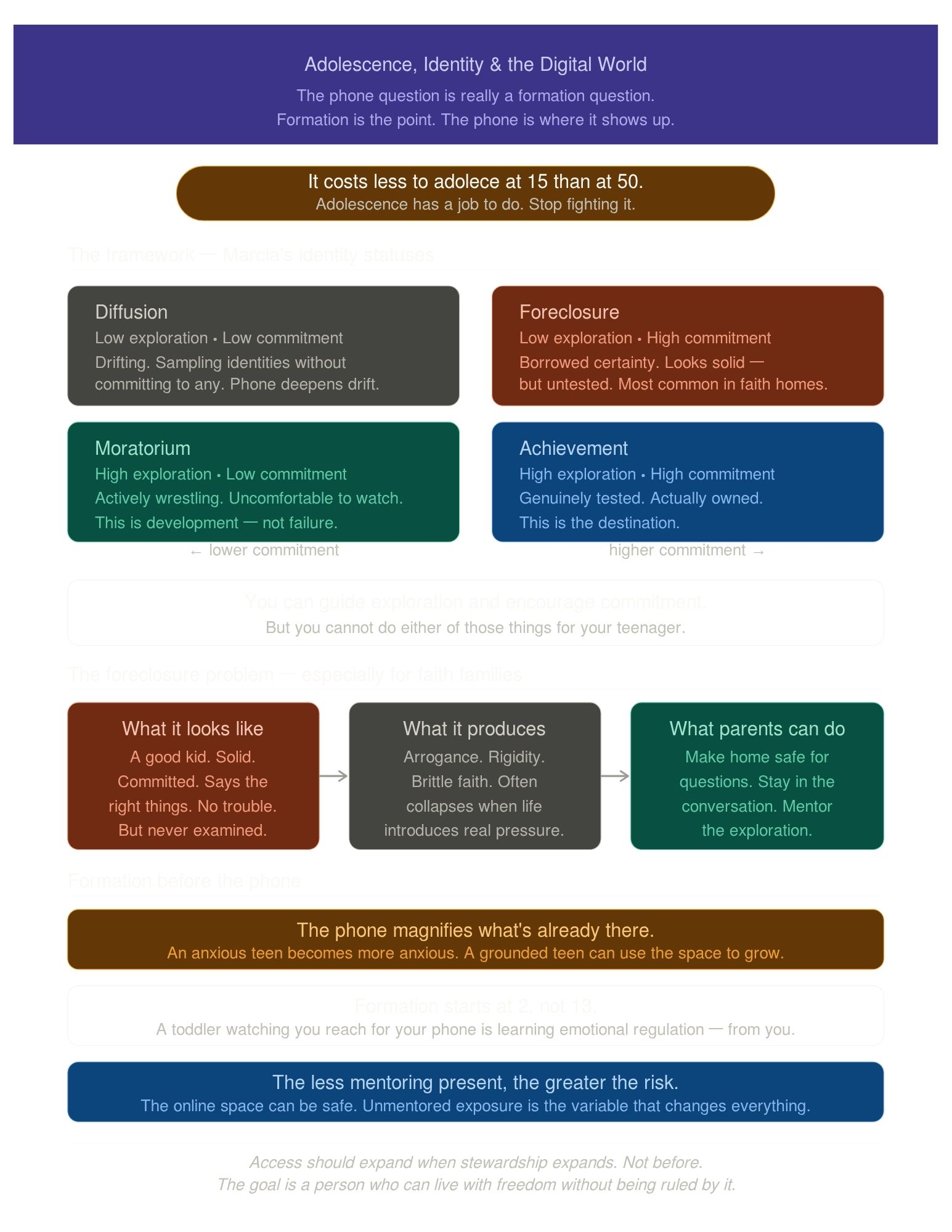
Marcia built on Erikson’s foundational work and identified that identity formation comes down to two things:
Exploration and commitment.
Exploration is the genuine wrestling — with ideas, with relationships, with questions about the future. Who am I? What do I believe? What kind of person am I becoming?
Commitment is what eventually comes from that process. Not a performance. Not borrowed certainty. A settled, owned sense of self that was actually arrived at.
And based on the presence or absence of those two things, Marcia identified four positions — four statuses — that tell you where a teenager is in their development right now.
Think of them as a barometer, not a verdict.
The Four Statuses
Diffusion — low exploration, low commitment.
This teenager has not really engaged the questions yet. They are not wrestling with who they are. They are not making meaningful commitments either.
They are drifting.
It can look like chronic apathy, shallow interests, an adolescent who avoids anything that requires them to take a real position. It is not laziness. It is usually an absence of the conditions that make exploration feel safe enough to try.
A phone given to a diffused teenager tends to deepen the drift. The digital world offers an endless stream of identities to sample without ever requiring commitment to any of them. Without mentoring, that adolescent can spend years scrolling through who they could be without ever moving toward who they are.
Foreclosure — low exploration, high commitment.
This teenager knows exactly what they believe. They are settled, certain, sometimes impressively so.
But the commitments were borrowed, not built.
They adopted the values, beliefs, and identity of their family or community without genuinely wrestling with whether those things are actually theirs.
I want to spend more time on this status in the next episode because it is the one I see most consistently in teenagers raised in strong faith households — and it carries consequences most parents do not see coming.
For now, just note this: foreclosure looks like stability. But it is the stability of a structure that has never been tested.
Moratorium — high exploration, low commitment.
This is the teenager who is actively in the middle of it.
Questioning. Pushing back. Trying things on. Uncomfortable. Maybe challenging what they were raised with. Maybe pulling away from the family’s beliefs or identity in ways that feel alarming.
This is the status that tends to panic parents the most.
But moratorium is not a crisis. It is development doing exactly what development is supposed to do.
The adolescent in moratorium needs two things above almost everything else: a safe environment to explore, and a mentoring relationship that stays present without trying to rush them to commitment before they are ready.
If you shut down the exploration, you do not eliminate the moratorium. You just drive it underground — or delay it until they are out of your house.
Achievement — high exploration, high commitment.
This is the destination.
Not certainty about everything. Not the absence of doubt or questions.
But a sense of self that has been genuinely tested and genuinely chosen. An adolescent who can say: I have sat with the hard questions. I have done the work. And I have arrived at commitments that are actually mine.
This is what formation, done well, produces.
And it is worth saying clearly: identity achievement is not a permanent state. Life introduces new domains, new pressures, new questions. A person can move through these statuses more than once across a lifetime.
But in adolescence, the goal is to move toward achievement — through exploration, not around it.
The One Insight That Changes Everything
Here is what my research keeps bringing me back to:
You can guide exploration and you can encourage commitment. But you cannot do either of those things for your teenager.
You cannot explore on their behalf. You cannot manufacture genuine commitment by applying enough pressure.
What you can do is create the conditions. Stay in the conversation. Ask real questions. Make your home a place where the exploration feels safe enough to happen out loud — rather than quietly, alone, online, without you.
That is the parent’s job.
And it is a different job than most parents think they signed up for.
The Framework in One Sentence
Marcia built on Erikson’s foundational work and identified that identity formation comes down to two things:
Exploration and commitment.
Exploration is the genuine wrestling — with ideas, with relationships, with questions about the future. Who am I? What do I believe? What kind of person am I becoming?
Commitment is what eventually comes from that process. Not a performance. Not borrowed certainty. A settled, owned sense of self that was actually arrived at.
And based on the presence or absence of those two things, Marcia identified four positions — four statuses — that tell you where a teenager is in their development right now.
Think of them as a barometer, not a verdict.
The Four Statuses
Diffusion — low exploration, low commitment.
This teenager has not really engaged the questions yet. They are not wrestling with who they are. They are not making meaningful commitments either.
They are drifting.
It can look like chronic apathy, shallow interests, an adolescent who avoids anything that requires them to take a real position. It is not laziness. It is usually an absence of the conditions that make exploration feel safe enough to try.
A phone given to a diffused teenager tends to deepen the drift. The digital world offers an endless stream of identities to sample without ever requiring commitment to any of them. Without mentoring, that adolescent can spend years scrolling through who they could be without ever moving toward who they are.
Foreclosure — low exploration, high commitment.
This teenager knows exactly what they believe. They are settled, certain, sometimes impressively so.
But the commitments were borrowed, not built.
They adopted the values, beliefs, and identity of their family or community without genuinely wrestling with whether those things are actually theirs.
I want to spend more time on this status in the next episode because it is the one I see most consistently in teenagers raised in strong faith households — and it carries consequences most parents do not see coming.
For now, just note this: foreclosure looks like stability. But it is the stability of a structure that has never been tested.
Moratorium — high exploration, low commitment.
This is the teenager who is actively in the middle of it.
Questioning. Pushing back. Trying things on. Uncomfortable. Maybe challenging what they were raised with. Maybe pulling away from the family’s beliefs or identity in ways that feel alarming.
This is the status that tends to panic parents the most.
But moratorium is not a crisis. It is development doing exactly what development is supposed to do.
The adolescent in moratorium needs two things above almost everything else: a safe environment to explore, and a mentoring relationship that stays present without trying to rush them to commitment before they are ready.
If you shut down the exploration, you do not eliminate the moratorium. You just drive it underground — or delay it until they are out of your house.
Achievement — high exploration, high commitment.
This is the destination.
Not certainty about everything. Not the absence of doubt or questions.
But a sense of self that has been genuinely tested and genuinely chosen. An adolescent who can say: I have sat with the hard questions. I have done the work. And I have arrived at commitments that are actually mine.
This is what formation, done well, produces.
And it is worth saying clearly: identity achievement is not a permanent state. Life introduces new domains, new pressures, new questions. A person can move through these statuses more than once across a lifetime.
But in adolescence, the goal is to move toward achievement — through exploration, not around it.
The One Insight That Changes Everything
Here is what my research keeps bringing me back to:
You can guide exploration and you can encourage commitment. But you cannot do either of those things for your teenager.
You cannot explore on their behalf. You cannot manufacture genuine commitment by applying enough pressure.
What you can do is create the conditions. Stay in the conversation. Ask real questions. Make your home a place where the exploration feels safe enough to happen out loud — rather than quietly, alone, online, without you.
That is the parent’s job.
And it is a different job than most parents think they signed up for.
The Framework in One Sentence
Marcia built on Erikson’s foundational work and identified that identity formation comes down to two things:
Exploration and commitment.
Exploration is the genuine wrestling — with ideas, with relationships, with questions about the future. Who am I? What do I believe? What kind of person am I becoming?
Commitment is what eventually comes from that process. Not a performance. Not borrowed certainty. A settled, owned sense of self that was actually arrived at.
And based on the presence or absence of those two things, Marcia identified four positions — four statuses — that tell you where a teenager is in their development right now.
Think of them as a barometer, not a verdict.
The Four Statuses
Diffusion — low exploration, low commitment.
This teenager has not really engaged the questions yet. They are not wrestling with who they are. They are not making meaningful commitments either.
They are drifting.
It can look like chronic apathy, shallow interests, an adolescent who avoids anything that requires them to take a real position. It is not laziness. It is usually an absence of the conditions that make exploration feel safe enough to try.
A phone given to a diffused teenager tends to deepen the drift. The digital world offers an endless stream of identities to sample without ever requiring commitment to any of them. Without mentoring, that adolescent can spend years scrolling through who they could be without ever moving toward who they are.
Foreclosure — low exploration, high commitment.
This teenager knows exactly what they believe. They are settled, certain, sometimes impressively so.
But the commitments were borrowed, not built.
They adopted the values, beliefs, and identity of their family or community without genuinely wrestling with whether those things are actually theirs.
I want to spend more time on this status in the next episode because it is the one I see most consistently in teenagers raised in strong faith households — and it carries consequences most parents do not see coming.
For now, just note this: foreclosure looks like stability. But it is the stability of a structure that has never been tested.
Moratorium — high exploration, low commitment.
This is the teenager who is actively in the middle of it.
Questioning. Pushing back. Trying things on. Uncomfortable. Maybe challenging what they were raised with. Maybe pulling away from the family’s beliefs or identity in ways that feel alarming.
This is the status that tends to panic parents the most.
But moratorium is not a crisis. It is development doing exactly what development is supposed to do.
The adolescent in moratorium needs two things above almost everything else: a safe environment to explore, and a mentoring relationship that stays present without trying to rush them to commitment before they are ready.
If you shut down the exploration, you do not eliminate the moratorium. You just drive it underground — or delay it until they are out of your house.
Achievement — high exploration, high commitment.
This is the destination.
Not certainty about everything. Not the absence of doubt or questions.
But a sense of self that has been genuinely tested and genuinely chosen. An adolescent who can say: I have sat with the hard questions. I have done the work. And I have arrived at commitments that are actually mine.
This is what formation, done well, produces.
And it is worth saying clearly: identity achievement is not a permanent state. Life introduces new domains, new pressures, new questions. A person can move through these statuses more than once across a lifetime.
But in adolescence, the goal is to move toward achievement — through exploration, not around it.
The One Insight That Changes Everything
Here is what my research keeps bringing me back to:
You can guide exploration and you can encourage commitment. But you cannot do either of those things for your teenager.
You cannot explore on their behalf. You cannot manufacture genuine commitment by applying enough pressure.
What you can do is create the conditions. Stay in the conversation. Ask real questions. Make your home a place where the exploration feels safe enough to happen out loud — rather than quietly, alone, online, without you.
That is the parent’s job.
And it is a different job than most parents think they signed up for.

 identitySPECIALIST